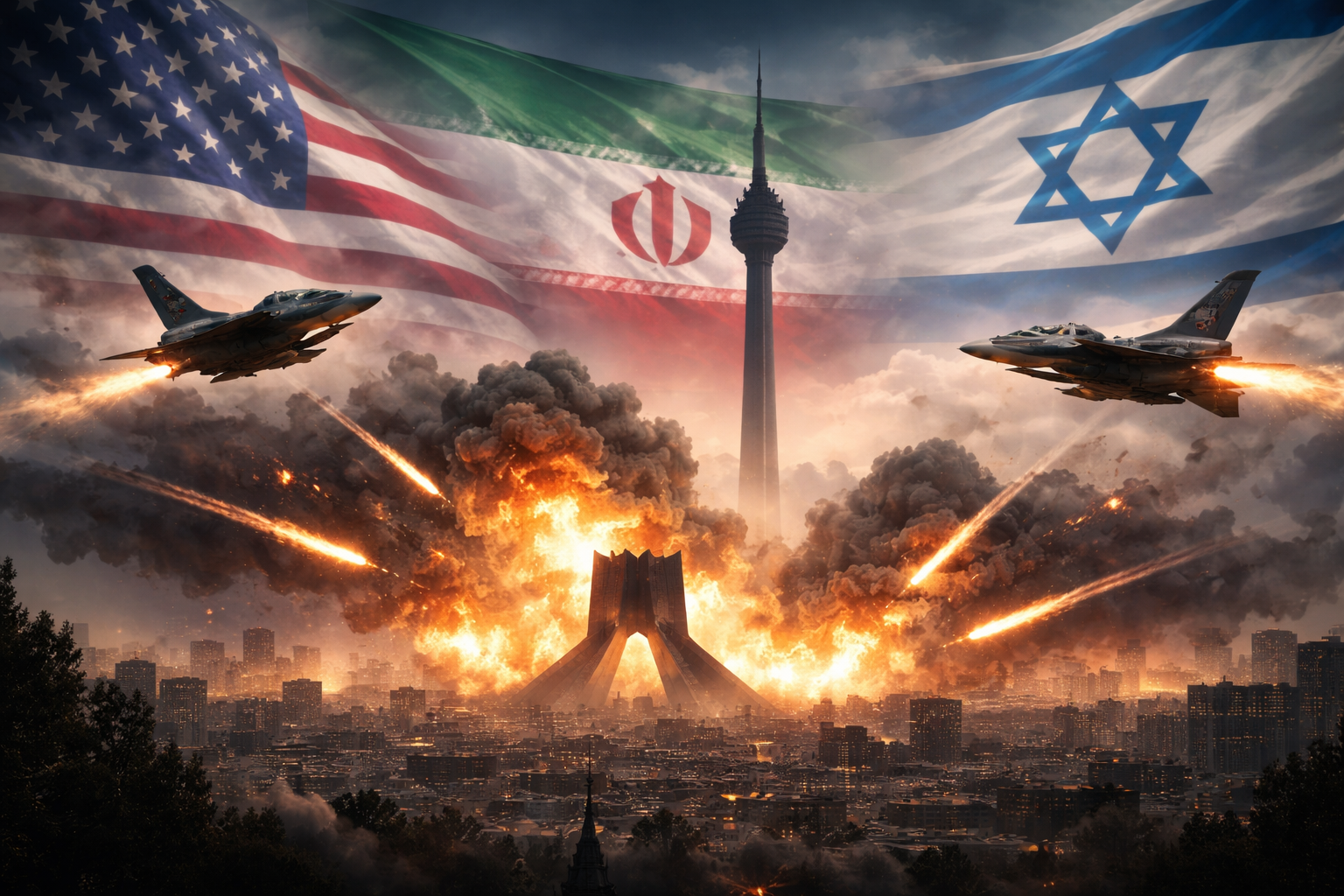
U.S. and Israel bomb Iran, killing Khamenei in a regime-change strike
One side sees an illegal war of choice with predictable blowback. The other sees overdue force against a terror-sponsoring theocracy racing toward nukes.
-
Framing centers the costs: Americans and people in the region pay for a choice made at the top. The fear is a widening war that turns bases, embassies, and cities into targets.
-
Responsibility is placed on leaders who chose decapitation strikes and called it regime change. Israel’s major role is framed as pulling the U.S. deeper into a regional fight.
-
The concern is two-track. Abroad, retaliation and escalation. At home, a precedent that major hostilities can start without a clear congressional vote.
-
The left argues decapitation does not solve the underlying conflict. It can fracture a country, empower hardliners, and create chaos. Critics also question whether domestic political incentives shaped the timing and messaging.
-
The moral demand is procedural and strategic. If the country is going to war, Congress should vote. If the goal is regime change, the plan and costs should be spelled out, not improvised mid-crisis.
They are portrayed as thrill-seeking hawks who treat war like branding, treat the Constitution like a speed bump, and externalize the human cost to troops and civilians.
-
Wire and major outlets report a joint U.S.-Israeli strike campaign hitting leadership-linked sites and military infrastructure, with continued waves of attacks.
-
Reporting describes Israeli warplanes and continued Israeli strikes, alongside U.S. involvement, as the conflict widens across the region.
-
Multiple outlets report Iranian state media confirmation of Khamenei’s death following the opening strikes.
-
U.S. Central Command reported the first announced U.S. fatalities linked to the operation, alongside additional injuries.
-
Early totals can change quickly. Reporting also describes uncertainty around succession mechanics and the internal balance between civilian leaders and security forces.
-
Reporting describes Iranian retaliation across the region and continued Israeli strikes. In Washington, lawmakers are debating what authority covers continued hostilities and what comes next.
- Left rejects: that killing leaders produces a stable transition, and that war can be launched without Congress.
- Right rejects: that restraint reduces danger, and that the regime can be contained while it backs proxies and advances nuclear capacity.
-
Framing centers long-term targeting through militias, rockets, drones, and terror plots. “Death to America” is treated as an ideology of the regime, not empty theater.
-
Responsibility is placed on Tehran’s leadership and security apparatus, seen as directing proxy forces while insulating itself behind deniability and distance.
-
The right frames the nuclear program as the core risk, with missiles and proxies as delivery and pressure tools. Crackdowns on protesters are cited as proof the regime cannot reform and will only get more dangerous.
-
The right argues diplomacy and limited strikes did not end the threat. They say the regime interpreted restraint as weakness and kept building capability through proxies and enrichment.
-
The moral claim is that removing the leadership and degrading core military systems reduces long-term risk. Israel’s deep involvement is framed as justified self-defense and alliance coordination.
They are portrayed as excusing a hostile regime, obsessing over procedure while missiles fly, and treating deterrence as provocation until Americans and Israelis are killed.
How two tribes interpret the same world
Both narratives agree the strike is historic. The split is what it means. The left reads it as a constitutional shortcut and a regime-change gamble that invites escalation and collapse. The right reads it as overdue force against a terror-sponsoring theocracy pursuing nuclear capability and crushing dissent. The disagreement is not over whether Iran is dangerous, but whether this path reduces danger or multiplies it.